This post is also available in: Català (Catalan) Español (Spanish)
On 3 June, we were invited to take part in the 31st REAS Aragón Economics Conference, held in Zaragoza, which focused on technology, free software, digital sovereignty, data, etc. REAS Aragón has produced a summary of the session which, with their permission, we have translated (into Catalan and English) and are sharing here.
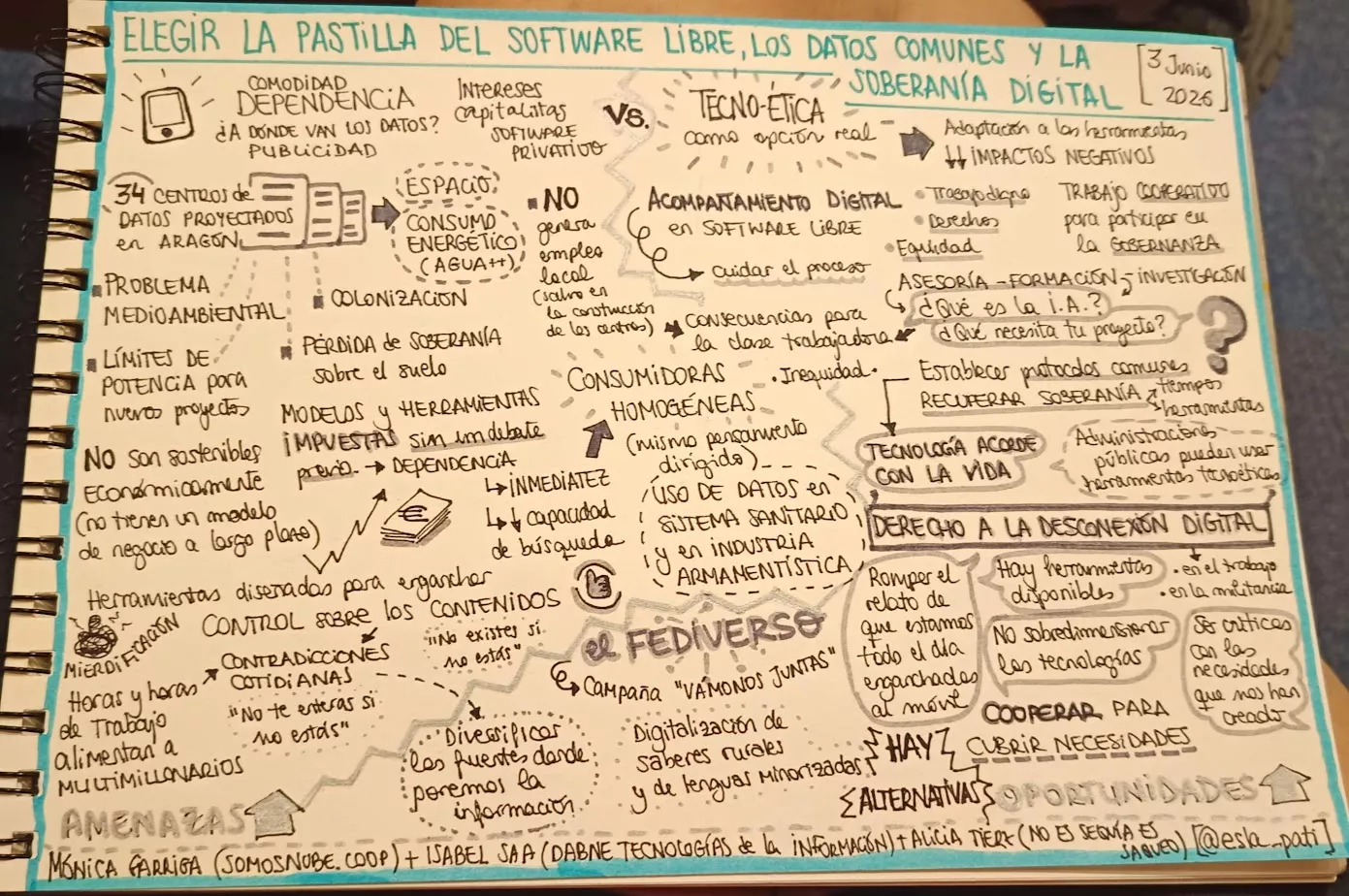
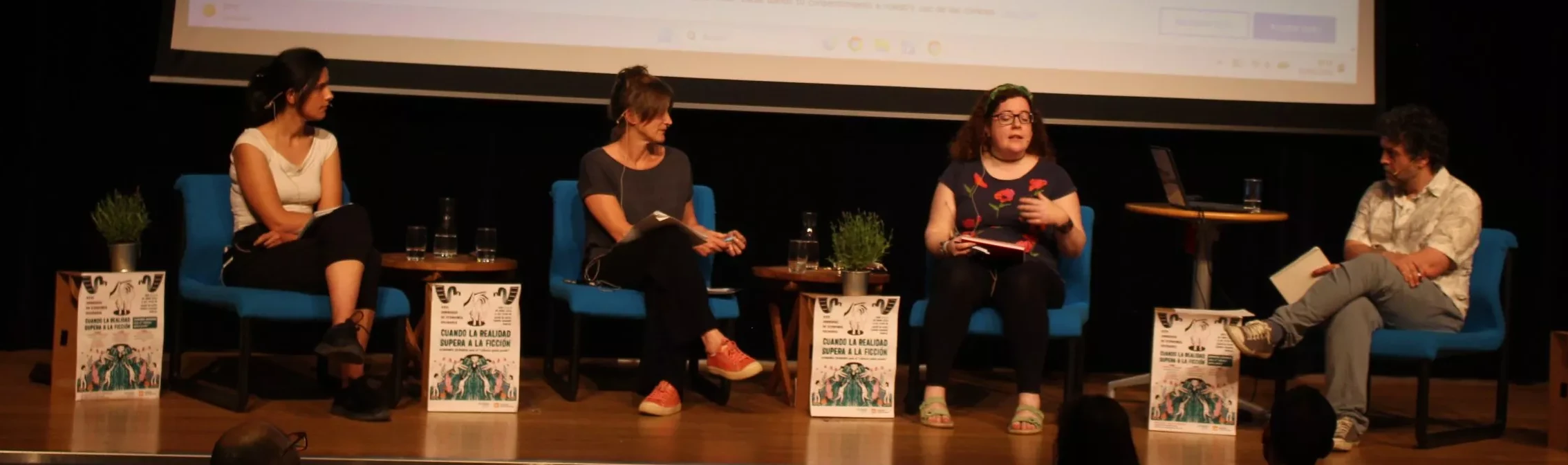
The third and final day of the 31st REAS Aragon Economics Conference focused on an area that is increasingly present in our lives, although often remains invisible: technology. Under the provocative title ‘Cooperative Matrix: choosing the pill of free software, common data and digital sovereignty,’ the session brought together Mònica Garriga from CommonsCloud Coop; Isabel Sea from Dabne Tecnologías de la Información; and Alicia Tires from “No es sequía, es saqueo” (‘It’s not drought, it’s plunder’) campaign.
The conversation began with a simple but unsettling observation: a large part of our communications, our data and our digital relationships depend on a handful of large tech companies. The applications we use every day to work, organise ourselves, stay informed or socialise may seem like neutral and accessible tools, but behind them are corporations with enormous economic, political and cultural power.
The speakers invited us to look beyond the convenience of these platforms and to ask ourselves who really controls the digital spaces we inhabit. The issue is not limited to privacy or the protection of personal data. It also affects societies’ ability to make decisions about an infrastructure that is becoming increasingly essential for daily life.
The concentration of power in the hands of large tech companies represents a loss of collective autonomy. Every message, every document stored, every digital interaction feeds business models based on data extraction and the creation of technological dependency. This power, in many cases, has more influence than that of numerous states and poses ever-increasing challenges to the quality of democracy.
From this perspective, digital sovereignty emerged as a profoundly political issue. It is not simply a matter of choosing one set of tools over another, but of asking ourselves what kind of society we are defending through our technological habits.
The Social and Solidarity Economy, the participants noted, cannot be left out of this debate. Just as it challenges the dominant models of production, consumption and financing, it must also reflect on the technologies it uses and the dependencies they generate.
Before adopting any tool, it was suggested that we return to a fundamental question: What needs do we really want to meet? We often adopt digital platforms without analysing whether they satisfy our own needs or simply reproduce a technological inertia that makes us increasingly dependent.
In response to this, the importance of incorporating free software tools, ethical technologies and cooperative models of digital management was highlighted. These are solutions that allow us to regain decision-making power, increase transparency and reduce our dependence on large corporations.
Far from adopting a fatalistic view, the speakers insisted that alternatives exist. There are cooperative platforms, services run within the social economy and technological projects built on the principles of democracy, transparency, and care. The challenge lies in generating the knowledge, the will, and the networks needed to use them.
The importance of diversifying the spaces where we store information, communicate or generate knowledge was also highlighted. Concentrating all our digital activity on a handful of platforms carries collective risks that often go unnoticed.
The debate on technological sovereignty was expanded by Alicia Tires, who shifted the discussion to the Aragon region and the tangible consequences of the expansion of the digital economy.
The “No es sequía, es saqueo” (“It’s not drought, it’s plunder”) campaign presented an analysis of the exponential growth of data centres in Aragon and the socio-environmental impacts associated with this process. This expansion is driven by institutional policies aimed at attracting investments linked to the digital economy, but the costs are borne by local communities and natural resources.
The presentation revealed a reality that often remains hidden behind the supposed immateriality of the internet. Every photograph stored in the cloud, every search and every digital service depends on enormous physical infrastructures that consume energy, water and land.
Data centres represent one of the least visible aspects of rapid digitalisation. Their proliferation raises questions about the use of shared resources, spatial planning and the environmental impacts of a technological model that is often presented as inevitable.
The session highlighted that talking about technology also means talking about democracy, natural resources and social justice. Decisions about how we communicate, where our data is stored or what infrastructure is built in our regions have consequences that go beyond the technical sphere.
At the close of the conference, this final roundtable served to broaden our perspective on contemporary challenges. While the first day focused on building active hope in the face of ecosocial despair and the second on strengthening mutual support networks to combat precariousness, the third day reminded us that transformation also involves reclaiming decision-making power over the digital environments we inhabit.
The choice of the “free software route” was not presented as a purely technological issue, but as an invitation to question dependencies, redistribute power and build alternatives consistent with the principles of the Social and Solidarity Economy.
Because sovereignty, also in the digital sphere, is not just a matter of resistance. It is about creating the conditions to collectively decide how we want to organise, communicate and live.